IKrasna Słoboda: 1898–1931
Before Antoni’s life became a route across three continents, it was a life in one small part of Volhynia.
Antoni Czerniachowicz was born on 26 March 1898 in Krasna Słoboda, near Novograd-Volyn, then in the Russian Empire. Family trees identify him as the eldest of seven children of Jan and Teofila. Several members are documented separately, though no direct household record has yet proved the full group. The family was Polish, while official papers later gave Antoni’s “previous nationality” as Russian. He was Polish by family, under Russian rule.
The wider Czerniachowicz line appears among the minor nobility of Volhynia. That gives context to the family’s local standing, but the records do not show that Antoni held an estate or was a landowner. They do not give his occupation, or explain why the Soviet state later selected him.
In a letter to his cousin Bolesław, Antoni recalled that “Tsar Nicholas called me up to the army still.” He would have been about nineteen. It is the only direct glimpse of his First World War service. In the same letter he called Bolesław “a little younger than me”, though the birth records show Bolesław was nine years older. The dates do not support the remembered age gap.
IIRepression and deportation: 1931–1942
By 1931, Soviet repression had reached Antoni’s home area. An interrogation file names an “Anton Ivanovich Chernyakhovich” in an alleged underground group around Katiukha. The surviving page records another accused man naming Anton in his testimony. It does not show Anton himself being questioned, or prove that the organisation and its allegations were real. The name may be Antoni. It may be another man from the same family line. The file cannot settle it.
Antoni’s own account is clearer. In 1973 he wrote that, with God’s help, he had “managed to avoid their hands in 1931”, and that he had several times nearly paid with his life. Records from the same year name two men arrested at Katiukha-Duby who match Józef and Stanisław in the reconstructed family. Antoni was close to the sweep, even if the protocol cannot prove that he was its “Anton”.
The repression continued. Records from 1937 and 1938 very likely refer to two of Antoni’s brothers: Józef, born in Katiukha-Duby to a father called Jan, was sentenced in January 1938 and died days later; another, Jan or Ivan, from the same village and with the same patronymic, was shot in October 1937. We have not found the direct record that proves either identity. Family memory says a third brother, Stanisław, died in the Second World War. No record for that death has been found.
In February 1940, Antoni was deported to Nizhnyaya Striga, in Kotlas district of Arkhangelsk Oblast. His Soviet special-settlement card gives an arrival date of 29 February 1940. He was released on 4 September 1941, under the Sikorski–Mayski amnesty for Polish citizens.
It was the first and largest of four deportation waves. Across the occupied east, people were taken from prepared lists, given little time to pack, and sent north and east in sealed goods wagons. Russian Memorial records count 98 trains carrying 138,616 people. The real number was probably higher. The train lists did not count every removal.
Polish people could be treated as political or social threats because of their identity, local status, work, suspected nationalism or earlier attention from the security services. The February 1940 lists also targeted military settlers, foresters, police and civil servants. Antoni was not a military settler. No document says which reason, if any, put his name on a list.
Nizhnyaya Striga was a posiolek, a special settlement. There was no trial, no sentence and no right to leave. The work in this district was timber. A commandant’s notebook from another settlement in the same district records 618 arrivals in the same week as Antoni’s, and at least eighty deaths before the 1941 amnesty. That tells us about the system around him. It does not tell us what Antoni’s own days held. He never described them.
Thirty-three years later, Antoni named the place himself: “They deported me to Arkhangelsk.” He added that in 1942 he had to return to work. By then, the route south was opening.
IIIExile: 1942–1950
After Germany invaded the Soviet Union, Stalin released General Władysław Anders to raise a Polish army from prisoners and deportees. Anders also took in civilians. Women, children and older people had reached the assembly points with the men, and there was no safe way for them to remain.
In two waves in 1942, 115,742 people crossed the Caspian from Krasnovodsk to Persia. 37,272 were civilians and 13,948 were children. A Polish evacuation list for August 1942 names Antoni Czerniachowicz, born 1898. Together with the route available to a released Polish civilian, it makes his escape through the Anders evacuation very likely.
What the journey cost
Antoni later said that his first wife died in 1942, while he was in Uzbekistan and travelling south. He did not say where she died. Their first daughter had already died in Poland, though he did not say when. He wrote that he married again in 1944. Helena was his second wife.
Helena
Helena came from a very different part of Poland. She was born on 23 January 1912 in Nowy Wiśnicz, south-east of Kraków, in Małopolska rather than Volhynia. Her maiden name was Smęda, as the family remembered. Her refugee records name her father as Maciej Smęda and her mother as Maria Enz. They support the remembered name, rather than the earlier assumption on this site. Related Smęda families are known in southern Poland, Piła, Toronto and Newfoundland.
Family memory places Antoni and Helena’s marriage in India. Polish refugee camps did run there from 1942 to 1948, but no document yet puts either of them in one. The available camp lists contain gaps. India remains possible, not proved.
Their 1948 application gives Antoni and Helena separate routes out of the Soviet Union, but records both at Koja from 20 December 1942. That date leaves the remembered 1944 marriage in India hard to place. The records do not show either of them leaving Koja and returning, so the conflict remains open.
Koja, Uganda
Koja was one of the “little Polands” that displaced families built in East Africa, with schools, chapels and a life organised around the camp. It was where Antoni and Helena began their family together. Their daughter Bogumiła was born there on 28 May 1945 and died on 24 August, aged three months. She was buried in the Koja cemetery, in grave 34.
Two independent records name Bogumiła, and Antoni’s letter says that a daughter of his second marriage died after three months. Family memory says another daughter also died in childhood, of malaria or pneumonia. No accessible record confirms a second child or a cause of death. The unrelated Koja burial of a Jadwiga Czerniak is not their daughter.
On 12 October 1946, Helena gave birth to twins, Maria and Józef, at Koja. Józef was my father. The 28 April 1950 nominal roll lists Antoni as head of a five-person household with Helena, the twins and Anna Tchurzewska, whom it calls his mother-in-law. The roll does not settle Anna’s exact relationship to Helena, whose own records name Maria Enz as her mother.
The camps were closing. The family also remembered a simpler reason for wanting to leave: Józef, still very small, caught malaria again and again at Koja. We do not know whether that changed the timing of their move. We know that, in the summer of 1950, they were offered a future in Britain.
IVEngland and later life: 1950–1983
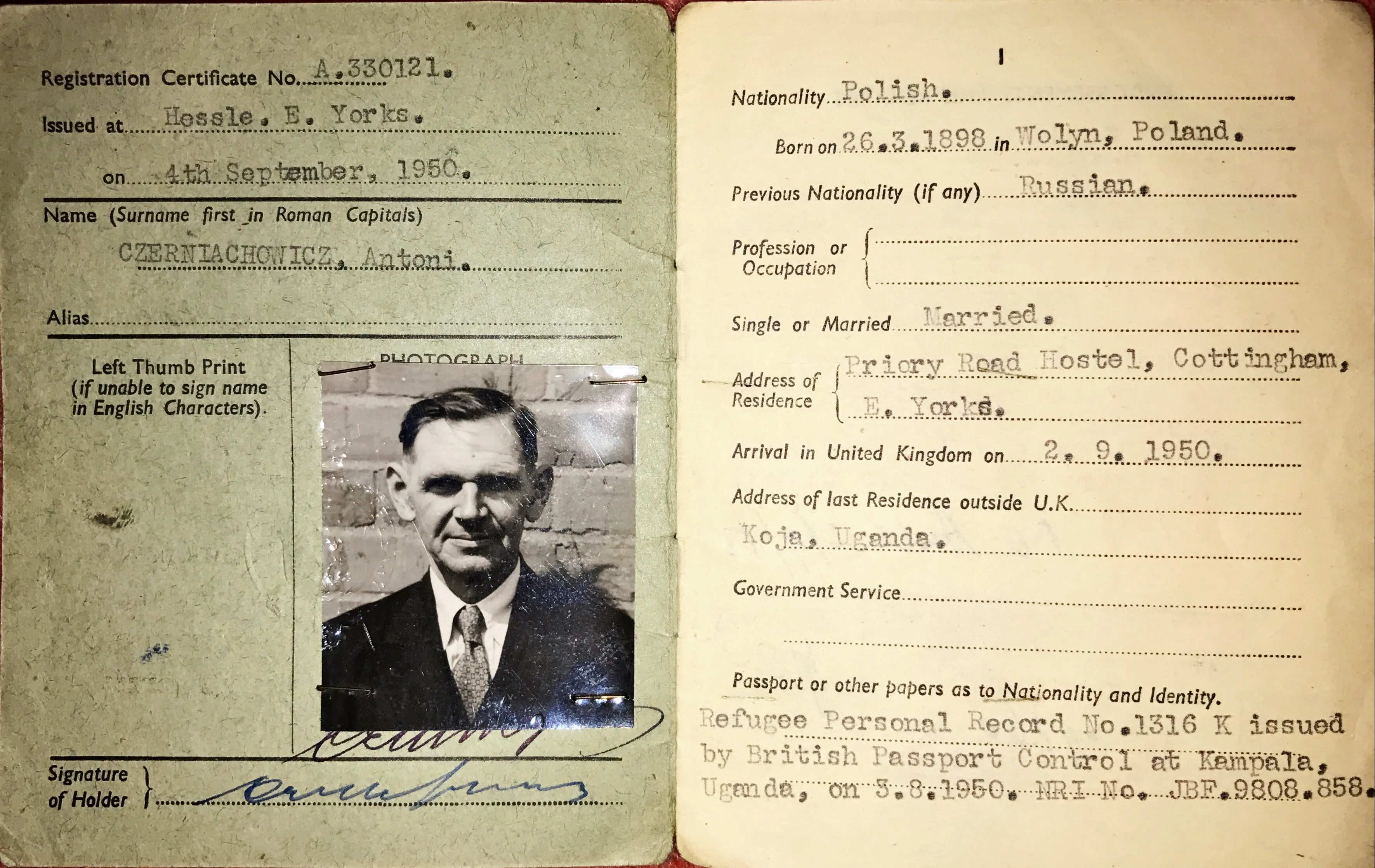
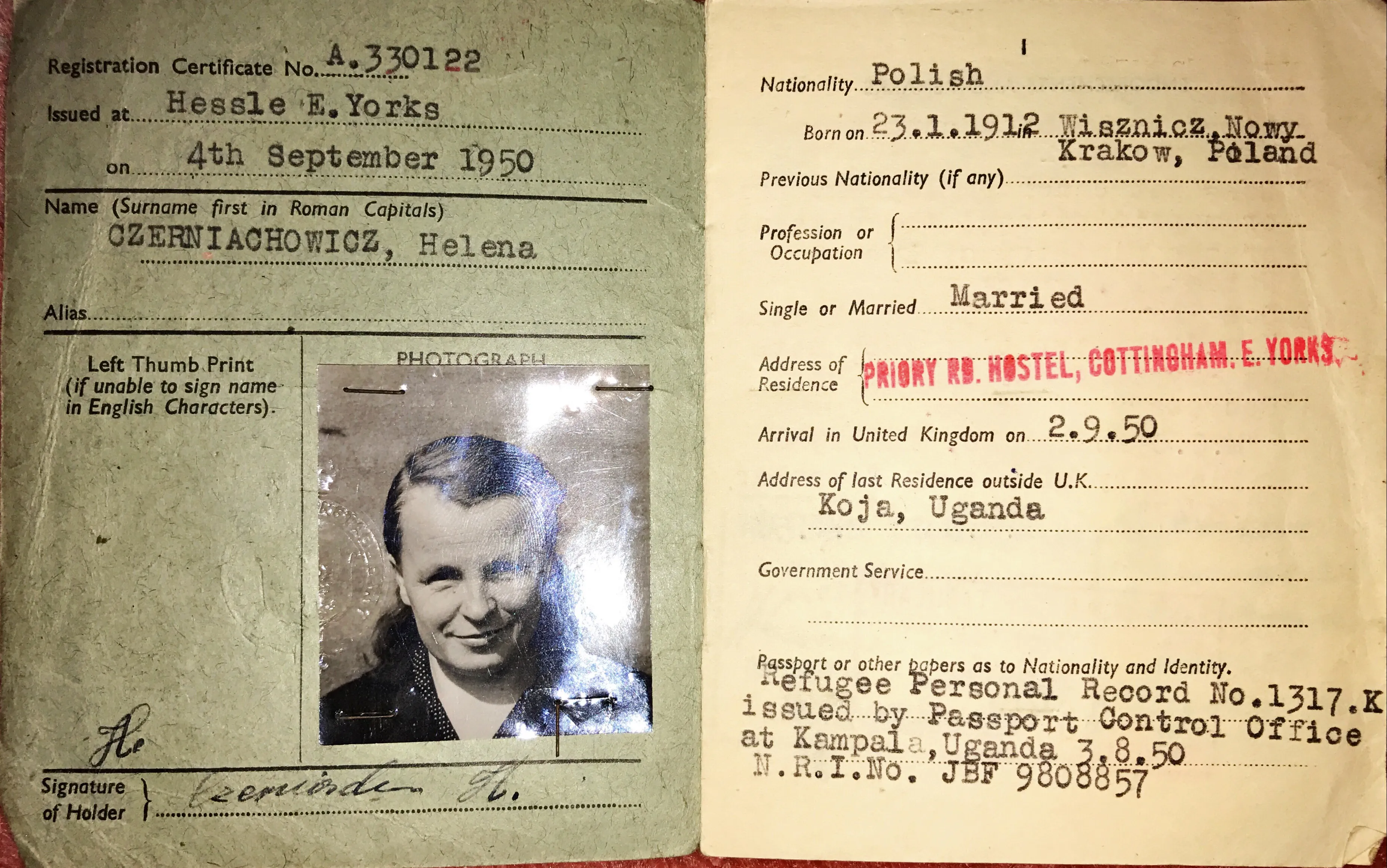
Antoni and Helena arrived in the United Kingdom on 2 September 1950. They first stayed at Priory Road Hostel in Cottingham, East Yorkshire. The sequential numbers on their registration certificates show they were processed together.
Registration certificates
| Antoni | Helena | |
|---|---|---|
| Certificate No. | A.330121 | A.330122 |
| Issued | Hessle, E. Yorks, 4 Sep 1950 | Hessle, E. Yorks, 4 Sep 1950 |
| Born | 26 Mar 1898, Wołyń | 23 Jan 1912, Nowy Wiśnicz, Kraków |
| Arrived UK | 2 Sep 1950 | 2 Sep 1950 |
| Last residence | Koja, Uganda | Koja, Uganda |
| First UK address | Priory Road Hostel, Cottingham, E. Yorks | (same) |
| Papers issued | Kampala, Uganda, 5 Aug 1950 | Kampala, 3 Aug 1950 |
The certificates do not name the ship, but the details point to the SS Dundalk Bay. It left Mombasa on 12 August 1950 and reached Hull on 1–2 September, carrying Polish displaced people. Its passengers passed through Priory Road, and 97 went on to Keevil, where Antoni’s children appear next. Port, date, hostel and camp all fit. No passenger list survives, so this remains a strong inference, not a proven voyage.
Keevil was a former wartime airfield near Trowbridge, run as a Polish community with a church, school, doctor and classes. The school roll names “Józio and Marysia Czerniachowicz”. Another family remembered the Czerniachowiczes as neighbours at Hut 393, Site 9. The camps were not prisons. Keevil gave the family housing, rations and a Polish community while they established themselves in Britain.
The family later moved into Trowbridge. Antoni’s letter records one more loss: a son born in 1951 who died just after birth. The family was in England by then, so the child was probably born and died there. No birth or death record found so far confirms where the child was born or died.
Family memory says Soviet representatives approached Antoni in England and urged him to return. He did not. It remains family memory, not a record.
The letters
The official papers take Antoni as far as 1950. His last years come from eighteen surviving letters to his cousin Bolesław in Poland, written between November 1971 and March 1979. They give him a voice again.
In January 1972, Bolesław invited him to visit. Antoni wanted to go, but said he could not. If provoked by “lies”, he would speak out, be called a reakcjonista, a reactionary, and “it would end badly”. He imagined Bolesław travelling in the Soviet Union on a “leash”. The refusal was political, not indifference. He kept writing, sending photographs and asking after the family.
They were both on old-age pensions by 1972. Arthritis was affecting Antoni by December that year.
In August 1973, Antoni looked back at 1931, his escape in 1939, Arkhangelsk and forced labour. Then he put it plainly: “I want nothing to do with them; I avoid them like fire.”
In December 1973 he explained what he wanted. “If Poland were free and independent, we would all return to the country. We long for our homeland like a small child for its mother.” Then he stopped himself: “But unfortunately I must finish, because regret wrings my heart.” By “country” he meant Poland, not Volhynia. Krasna Słoboda was in Soviet Ukraine after the war.
In 1973 Józef worked as an electronics inspector, escaped a serious car crash, and married Barbara later that year. Maria had married David and lived nearby with their son Simon.
In June 1974, Maria and David planned a three-week trip around Poland in their own car. Helena intended to go with them to visit her siblings, even as her arthritis was “tormenting” her. The letter does not say whether the journey went ahead.
In December, Antoni walked Simon to school, a kilometre and a half each way.
By 1977 Antoni’s hands were “completely paralysed”. In 1978 Helena spent four weeks in hospital with little improvement, and Maria and David visited Canada. Yet the letters continue in the same careful script.
The last surviving letter does what no archive had managed. In March 1979, Antoni asked Bolesław to visit his sister Jadzia, who lived at Rychalsk station near Stara Huta. Her birth was known. No later record had found her. Here she was, aged seventy-two, still near the family’s home ground.
Antoni had used two names for one place. A clearer 1977 letter reads “Rychalsk”; Stara Huta had been renamed Rychalske in 1963, after the station. He was naming the place he had known, and the place it had become while he was away.
In that last letter, Antoni wrote that Bolesław might visit England in 1980: “if we live to see it, we’ll be glad.” Antoni died in 1983. The papers do not say whether the visit happened.
My father Józef was born in the camp at Koja. He preferred to call himself stateless, and went on saying it until he died in 2023. I get called Polish by the English, and English by the Poles.
Three generations in, the question of where home is has not settled.